
















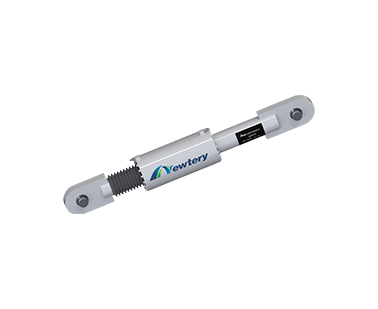
Vibration-Seismic Integrated Control Damper
-
 Product Images
Vibration-Seismic Integrated Control Damper
Product Introduction
The Vibration-Seismic Integrated Control Damper is an intelligent energy-dissipating device for longitudinal vibration and seismic control. It integrates temperature-adaptive adjustment and multi-working-condition load response functions. Through the synergistic action of spring and damper, it realizes the integrated control of temperature deformation adaptation, vibration suppression and seismic energy dissipation, addressing the problem of performance imbalance of traditional restraint systems under different velocity conditions.
Its core principle is based on the velocity graded response + temperature adaptation mechanism, enabling precise control for three types of working conditions.
1. When the main girder deforms slowly due to temperature changes, the damping medium flows freely through the piston overflow orifices, achieving thermal stress release and deformation adaptation.
2. When high-frequency and small-amplitude vibrations occur at the Girder ends caused by vehicle live loads and fluctuating wind, the spring elastic force and the constant damping force of pistons on both sides form a synergistic restraining force, which can efficiently suppress reciprocating vibrations, reduce structural fatigue damage and realize elastic reset function simultaneously.
3. When longitudinal large deformations are induced by earthquakes, the damper achieves high-efficiency energy dissipation and reduces the displacement response of Girder ends.
When working under medium-velocity vibration conditions, the constitutive relation of the damper satisfies the formula:
F = kx + Fh
F: Limiting/restraint force (kN)
k: Spring stiffness (kN/mm)
Fh: Constant damping force (kN)
x: Displacement (mm)
When working under high-velocity vibration conditions, the constitutive relation of the damper satisfies the formula:
F = 2Fh + CVα
F: Rated damping force (kN)
Fh: Constant damping force (kN)
C: Damping coefficient (kN/(m/s)α)
α: Velocity exponent
V: Maximum response velocity (m/s)
Advantages and Features
-
 Full-Condition Adaptability
Overcomes the limitations of traditional dampers, such as ‘low efficiency at medium speeds and overload at high speeds,’ covering all scenarios including temperature effects, vibration, and seismic events.
-
Temperature Self-Adaptation
Requires no manual intervention. Through the physical response of overflow orifices and the damping medium, it maintains stable damping performance across a temperature range of -30°C to 60°C, solving the temperature sensitivity issues common in flui
-
Structural Safety
Combines spring elastic reset with damping energy dissipation, capable of limiting the maximum relative displacement under extreme conditions to protect structural safety.
-
Outstanding Economical Efficiency
Simplifies the traditional ‘multiple-device separate control’ approach, reduces the required design displacement for Girder-end expansion joints, and lowers maintenance costs over the entire lifecycle.